


Families research online, compare several schools and expect quick, personal replies. This guide covers how to reach the right families, run open days that turn visits into applications, and follow up so no family slips through.
Marketing a school isn't like marketing a product. Families aren't buying once. They're choosing a community their child will grow up in, often for a decade or more, and the decision is shared between parents, grandparents, the child and, more often than you'd think, the parents they meet at the school gate.
That makes school marketing slower, more personal and more dependent on trust. Most schools are good at the moment of attraction: a strong website, a polished prospectus, a well-run open day. Where they lose families is in the weeks either side of those moments, when replies are slow, follow-up is patchy and nobody can say which channel brought in the families who enrolled.
1. How Families Choose a School Today
Before you plan a single campaign, it helps to see the decision from the family's side. Most families move through four stages:
- Listening. Families ask friends, colleagues and other parents long before they contact a school. In one study of private-school families, 60% said their conversations were mostly with other parents already in private education.1
- Researching. Your website, social channels, review sites and directories. Families are building a shortlist.
- Visiting. An open day, tour or virtual session is where a shortlist becomes a favourite.
- Deciding. The final choice often comes down to how families were treated along the way.
That last stage matters more than most schools expect. Families notice silence. A slow reply after an enquiry, or a week of nothing after an open day, reads as a sign of what the school will be like once their child is enrolled.
Read a parent's view of the admissions process here.
2. Start with Your Marketing Foundations
Know what makes you different
Most school websites say the same things: caring community, academic excellence, global outlook. Write down the three things a family would only get at your school, and the evidence for each. Then ask current parents why they chose you, in their words, and use their language.
Define the families you're trying to reach
A family moving across the world for work, a local family weighing you against a free state or public school and a family looking for boarding are three different audiences. For each, note who they are, what worries them, where they look for information and when they decide.
Make your website answer the real questions
Your website is your most visited admissions office. A parent should find fees, entry points, key dates (including your next open day), a short enquiry form and real family stories within two clicks of the homepage.
3. Choose the Channels That Bring the Best Enquiries
You don't need to be everywhere. Find out which channels bring families who apply and enrol, then put more behind them. Most schools draw on the same eight:
- Current parents and referrals: ask happy families to share open day invitations.
- Search (SEO): answer the questions parents type, from fees to "best international schools in [city]".
- Paid search: bid on your school's name and high-intent terms.
- Social media: real school life outperforms polished adverts.
- Paid social: promote open days to families near you, by location and life stage.
- Relocation agents and employers: give each a simple pack and their own tracking link.
- Community events and feeder schools: collect contact details at every one.
- Directories and review sites: keep listings accurate and reply to reviews.
Give every channel its own tracking link from day one. Then you can see which brought the enquiry, the visit, the application and, eventually, the enrolment. And give families who aren't ready to apply a low-commitment way to stay in touch, such as a prospectus download, a newsletter or a webinar.
4. Turn Enquiries into Relationships with an Admissions CRM
Marketing brings families to your door. What happens next decides whether they enrol. An admissions CRM holds every family's enquiry, emails, event bookings, conversations and application in one place, from the first click to the first day. It gives you one record per family, mailing lists that build themselves, short nurture emails, logged conversations, lead scoring so your team knows who to call first, and source tracking all the way to enrolment.
Find out how to build a stronger spring pipeline with a CRM here.
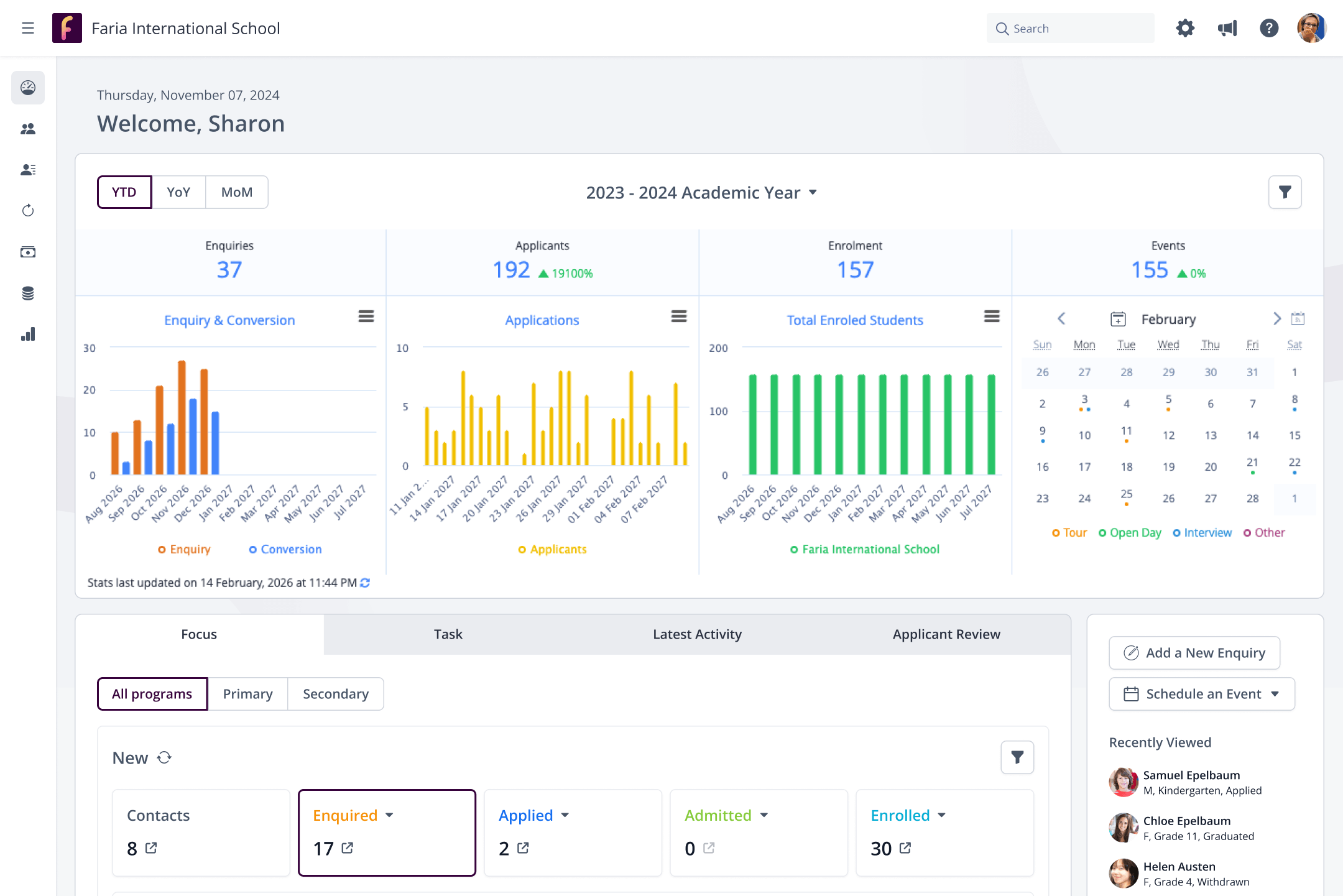
Does it make a difference? OpenApply looked at eight years of admissions data (2018 to 2025) from schools with at least two active admissions cycles. Nine in ten grew their applications. The median school grew its applicants 4.4 times over its time on OpenApply, and schools using the full CRM grew 5.7 times. That's a pattern across schools, not a guarantee for any one of them, but it points the same way: schools that actively drive their funnel tend to grow faster.
Read the full eight-year admissions report here.
Why a school CRM, not a general one? Salesforce and HubSpot are built for sales pipelines that move in a straight line. School admissions moves back and forth, involves siblings and has to map to grades, entry dates and capacity. Schools that adapt a general CRM often end up with workarounds and systems bolted together.
Compare OpenApply, Salesforce and HubSpot here.
5. Plan and Promote an Open Day That Fills Seats
An open day is where a shortlist becomes a favourite. It also asks a lot: staff give up a Saturday, students show the campus at its best, and families make time to come. Plan it so that effort turns into applications.
Choose the right format
One big open day rarely suits every family. Most schools do best with a mix of open mornings or open houses, personal tours for families close to deciding, small-group sessions by year or grade, live virtual events for overseas families, shadow or trial days for older students, and themed events that show off a strength.
Open day ideas that families remember
- Let student ambassadors lead the tours.
- Show real lessons, not empty classrooms.
- Keep the Head of School's talk to fifteen minutes, then take questions.
- Plan something for younger siblings and time with peers for older applicants.
- Give every family a next step before they leave.
Build an eight-week countdown
- 8 weeks out: set dates, formats and capacity.
- 7 weeks out: build the registration form and agree your follow-up messages.
- 6 weeks out: invite last year's enquirers, siblings and existing contacts.
- 4 weeks out: launch social, paid and partner promotion, each with its own tracking link.
- 1 week and 2 days out: send reminders, and brief student ambassadors and staff.
- On the day: check families in, log conversations and book next steps.
Segment your invitations, too: a Reception/Kindergarten parent and a Year/Grade 9 parent want different open days. Keep the registration form short, confirm straight away, and offer a virtual tour to anyone who can't make the date.
6. Follow Up After the Open Day
Most families visit more than one school in the same season. The school that follows up quickly, personally and with a clear next step stays at the top of the list. This is also where most schools lose families: between a visit and an application.
- Reply within 24 hours, with the Head of School's talk, a link to apply and a named contact.
- Send different messages to different families. Families who attended, booked but didn't come, or started applying each need their own email.
- Give every family one next step. One clear ask beats five links.
- Call your most engaged families. A personal call is worth more than any email.
- Stop when they act. Once a family starts an application, take them out of the sequence.
Doing this by hand for every family, after every event, is where good intentions fall apart. An admissions CRM can send each group the right message automatically, alert the right person when a family takes a key action, and stop the sequence the moment a family applies.
Find out where families drop out of your admissions funnel here.
7. Measure What Worked, and Keep the Families You Win
Your board and leadership team will want to know what your marketing delivered. Track enquiries by source, conversion between each stage, open day attendance, the days between stages, enrolments by source and re-enrolment. Look at each stage separately: an overall rate hides where families leave.
Keeping families is marketing too. Every family who re-enrols is a seat you don't have to fill again. Make re-enrolment as easy as applying, with one click for every sibling, pre-filled forms and online deposits. At British School Manila, 88% of families re-enrolled within a week, rising to 93% within two. At The American School of Milan, parents re-enrol in under two minutes.
Running admissions across a school group? Read more here.
8. School Marketing FAQs
How do I market my school to new families?
Start with what makes your school different and who you're trying to reach. Then choose a few channels those families use, give each one its own tracking link, and follow up every enquiry quickly. Current parents and referrals are often your most trusted channel.
How far in advance should we plan an open day?
Allow about eight weeks. That gives you time to set dates and formats, build a registration form, invite existing contacts first, then promote more widely four weeks out, with reminders a week and two days before.
How do we get more families to attend our open day?
Invite warm contacts first, segment invitations by entry year or grade, keep the registration form short, confirm instantly and send two reminders. Offer more than one slot, including a virtual option for families who can't travel.
What should we do after an open day?
Thank every family within 24 hours, with a clear next step. Send different follow-ups to families who attended, families who booked but didn't come, and families who started applying. Call the most engaged families personally.
What is an admissions CRM?
Software that keeps every prospective family's enquiries, emails, event bookings, conversations and application on one record. It helps schools nurture families before they apply, prioritise follow-up and see which channels lead to enrolments.
Can we use HubSpot or Salesforce for admissions?
You can, but general CRMs are built for linear sales pipelines. School admissions moves back and forth, involves siblings and must map to grades, entry dates and capacity, so schools often need extra configuration and workarounds.
How do we measure whether our school marketing is working?
Track enquiries by source, conversion between each stage, open day attendance, time between stages, enrolments by source and re-enrolment. Stage-by-stage numbers show where families drop out, so you know what to fix.
Final Thoughts
Great school marketing reaches the right families, then never loses track of them. OpenApply brings your enquiries, open days, follow-up, applications and re-enrolment into one platform built for schools, so your team spends its time on conversations, not spreadsheets.
Plan your next open day with our free guide, Open Days That Fill Seats.
See OpenApply in action. Book a demo.
1 Tarkhnishvili, L. & Tarkhnishvili, A. (2022), "Factors Influencing the Choice of Private or Public School". [Primary source link to add.]