


Every admissions team wants more enquiries. Far fewer stop to ask what happens to the enquiries they already have. Yet that is where intakes are won or lost, not at the top of the funnel, but in the middle, where families quietly slip away between first contact and enrolment. As you prepare for the year ahead, the cheapest growth available is not more leads. It is keeping the ones you already attract.
|
Summary
|
Where Are You Actually Losing Families?
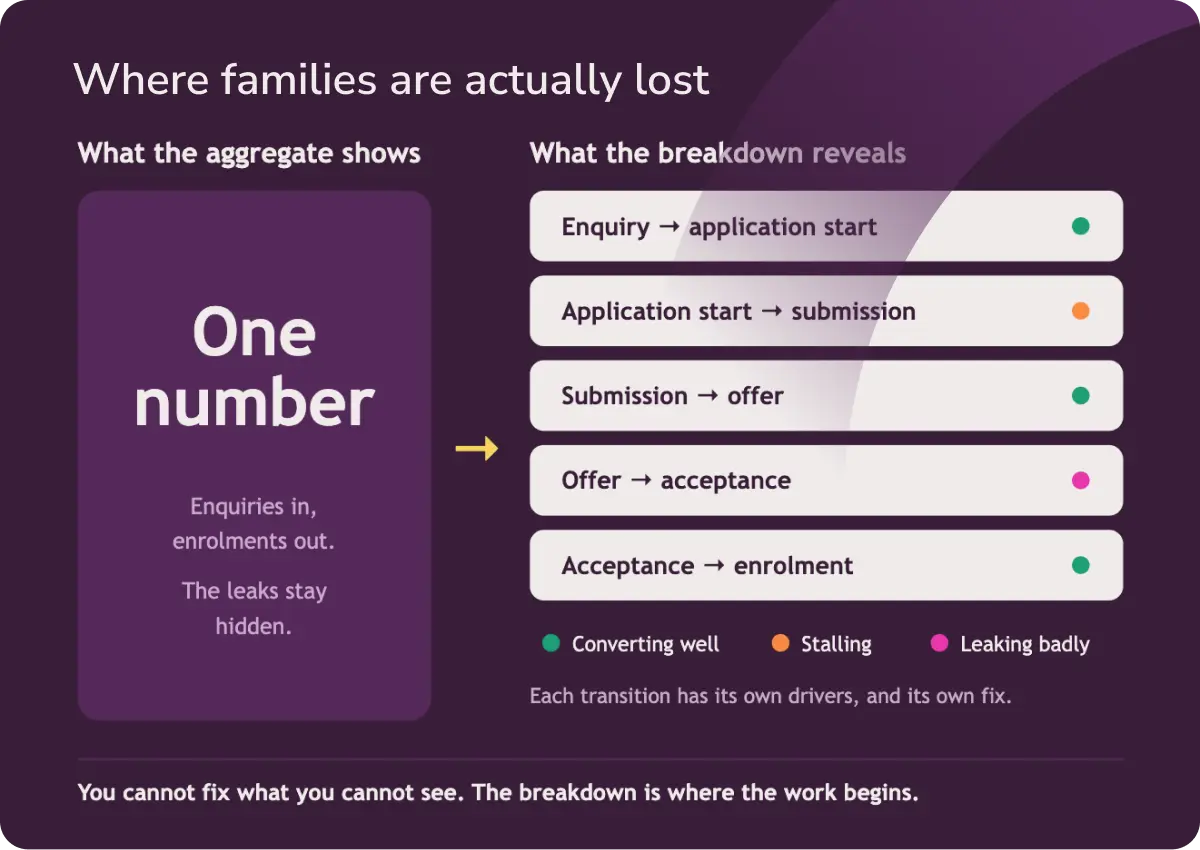
It is tempting to treat admissions as a single number: enquiries in, enrolments out. But that aggregate hides the real story. A school that turns 500 enquiries into 40 enrolled students has an 8% full-funnel conversion rate, which sounds healthy enough. What the headline number conceals is that 460 families decided, somewhere along the way, that the school was not for them.
The drop-off happens stage by stage, and each stage has its own leak. Across the admissions sector, typical benchmarks should run roughly like this, according to Cube Creative Design, a US specialist in private school marketing: inquiry-to-tour around 40 to 50%, tour-to-application around 60 to 70%, and application-to-enrolment around 75 to 85%. The compounding effect is brutal, which is why the full-funnel conversion rate from first enquiry to enrolled student often sits closer to 3 to 5%.
The lesson is not to panic at the numbers, which vary widely by school type and market. It is that you cannot fix what you cannot see. Aggregate conversion rates hide more than they reveal; breaking the funnel into discrete transitions, enquiry to application start, start to submission, submission to offer, offer to acceptance, acceptance to enrolment, reveals where the problems actually live. A school losing families at the application stage needs a completely different fix from one losing them at first contact. Without stage-by-stage visibility, every intervention is a guess.
Why Does the Middle of the Funnel Leak Most?
Enrolment is rarely lost at the moment of awareness. It is lost in the follow-up. And the most common culprit is painfully simple: speed.
The research here is striking, and consistent across sources. Responding to an enquiry within five minutes is up to 21 times more effective than waiting 30 minutes, yet up to 70% of school enquiries never receive a direct human response at all. The classic study underlying this, from Harvard Business Review, found that firms contacting a prospect within an hour were nearly seven times as likely to have a meaningful conversation as those waiting just an hour longer, while the average response time across the firms audited was 42 hours.
For a school, that gap is the difference between winning and losing a family, because families do not wait. Hyperleapai cites that 30% of leads who do not receive a fast response will actively seek information from a competitor. When a parent contacts your school, they are very often contacting several others at the same time. The school that replies first, and replies personally, has a structural advantage before the conversation has even begun.
The second great leak is friction. Complicated forms, unclear document requirements, and a process that makes a family chase the school rather than the other way round all cause motivated applicants to drift. High drop-off at the application stage usually points to poor follow-up, complicated application forms, or friction in the process itself. Every extra step that is not strictly necessary is an invitation to give up.
The schools that win here are the ones that make the process effortless. The American School of Milan found that after implementing OpenApply, families complete re-enrolment in under two minutes by confirming their details and signing digitally, where the old paper-based system had been cumbersome and slow.
What Closes the Gaps?
The good news is that the biggest levers are also the most fixable. Three things move the needle more than anything else.
1. Speed of Response
At minimum, set up an automated acknowledgement that fires immediately on form submission, followed by a personal response from an admissions team member within 24 hours. An instant acknowledgement buys you time and reassures the family; the personal follow-up then does the real work. The point is that no enquiry should ever fall into a void.
2. Removing Friction from the Application Itself
Review your forms before the season starts and cut anything that is not essential at that stage. Make the document requirements clear and the next step obvious. A family should never have to wonder what happens next or what you need from them.
3. Visibility
You cannot tighten response times or spot a stalling application if your enquiries live in scattered inboxes and personal threads. Many institutions still rely on disconnected systems where marketing captures leads in one platform and admissions tracks them in another, and this fragmentation creates blind spots, duplicated effort, and missed opportunities to engage families at critical moments. One clear view of the whole funnel is what turns drop-off from an invisible loss into a fixable problem.
There is a less obvious benefit too. When the admin no longer consumes the day, the team is freed to do the work that actually converts families: the personal conversations, the thoughtful follow-up, the relationship building. As Caterham School's Deputy Head of Admissions put it, the right system leaves the team "the bandwidth to be registrars rather than spend time on data entry."
How OpenApply Helps You Keep the Families You Attract
This is precisely the problem OpenApply is built to solve. It brings the entire admissions journey into one place, so the leaks that cost schools families are visible and addressable before they widen.
Every enquiry lands in one system rather than a scatter of inboxes, so nothing falls through the cracks and the team can respond fast, the single highest-leverage thing an admissions team can do. Automated workflows acknowledge families immediately, prompt them for outstanding documents, and keep applications moving, which strips out the friction that stalls motivated applicants. Families self-serve through a clear portal, tracking their own progress rather than waiting on the school. And a single funnel view shows leadership exactly where families sit, which stages are converting and which are leaking, so effort goes where it will actually recover enrolments.
The results schools see bear this out. British School Manila, having moved off an inefficient paper-based process and onto OpenApply, re-enrolled 88% of families within one week and 93% within two. These are the families a school already has; losing fewer of them is the fastest enrolment growth available.
The schools that fill their seats are rarely the ones with the most enquiries. They are the ones that lose the fewest families between first contact and first day. Going into your next intake, that is the difference worth investing in, and it is what OpenApply is designed to deliver.
Want to see where your admissions funnel is losing families, and how to close the gaps before your next intake?
We'll show you what full funnel visibility looks like in practice.