


For most families, the admissions team is their first real contact with your school. Long before they meet a teacher or walk into a classroom, they've sent an enquiry, waited for a reply and started forming a view of how your school works.
That's why admissions isn't an administrative process for collecting applications. It's where your school builds its first relationship with a family. How quickly you reply, how clearly you explain what happens next, and whether you remember what a family told you last time all signal how the school operates day to day. Families notice, and it strongly shapes whether they enrol.
Many schools still treat admissions as a processing job: wait for the application, check it's complete, make a decision. The schools growing fastest treat each family as a relationship to build, not a file to process. Here's what that shift looks like in practice.
|
Collecting applications |
Managing relationships |
|
Waits for the form |
Starts at the first enquiry |
|
Contacts families when something's missing |
Contacts families to answer their concerns |
|
Team chases by hand |
Systems handle reminders, team handles conversations |
|
Measures applications received |
Measures how many families move forward |
Working Harder Won't Fix It

When admissions numbers dip, the instinct is often to ask the team for more: chase harder, send more emails, stay later through the busy season. It rarely works, because the problem usually isn't effort.
Most admissions teams are already stretched. Open days, tours, interviews and assessments all compete for the same few people. If follow-up depends on someone remembering, and the pipeline lives in spreadsheets and inboxes, families will slip through, no matter how committed the team is.
Research outside education shows the same. In a Harvard Business Review study of 1.25 million sales leads, companies that contacted a prospect within an hour were nearly seven times more likely to have a meaningful conversation than those that waited even one hour longer. The researchers traced most delays to how leads were handled, not to how hard people worked: enquiries pulled from systems once a day rather than as they arrived, and rigid rules about who should pick each one up.
Building relationships with every family depends on processes and systems that make the right action the easy one: every enquiry in one place, follow-up that happens on time without anyone having to remember it, and a clear view of where each family stands. That frees your team to do what only people can do: have real conversations with families.
Schools That Work the Whole Funnel Grow Fastest

Our Admissions Performance Report looked at eight admissions cycles of OpenApply data, from 2018 to 2025. Among schools with a multi-year run on the platform, nine in ten grew their applications, and the median school grew its applicant numbers 4.4 times.
The strongest growth came from schools using OpenApply as a full admissions CRM: actively following up with families across the pipeline rather than only collecting forms. Those schools saw applicant numbers grow by a median of 5.7 times.
That growth came from catching more families at the start of their journey, then losing fewer of them on the way to enrolment. Below, we look at each of the four stages from the family's side:
-
Capture every enquiry
-
Nurture the pipeline
-
Convert with less friction
-
See the whole picture
These figures describe what happened across our schools, not a guarantee for any one school. But they point clearly to where the work is worth doing.
1. Capture Every Enquiry
Every enquiry is the start of a relationship. A reply that gets lost or arrives days later means the relationship never starts. It also tells the family something before you've said a word: that the school isn't paying attention.
This happens more often than most schools realise. When customer experience firm insight6 made out-of-hours mystery calls to UK independent schools, presenting the results at the 2026 AMCIS conference, 80% of calls went to voicemail, and 80% of those voicemails were never returned. In higher education, Edified's 2023 Enquiry Experience Tracker found that 93% of prospective students who had a negative enquiry experience said they wouldn't engage with that institution again.
The fix starts with getting every enquiry into one place. In many schools, enquiries arrive through half a dozen routes: the website, the main office inbox, open days, agents, a parent who mentions a friend at the school gate. When they all feed the same system, no family falls through the gaps between inboxes, and every enquiry gets a reply.
It also helps to know where each family came from. If you can see that one open day produced more applicants than a term of paid social, you can put next year's time and budget where it works.
Finally, make it easy for families to keep going. Every separate form, every “please email us your documents”, is a point where a family can drift away. The fewer handoffs between enquiry, application, documents and payment, the more families make it through.
What good looks like: every enquiry in one central system, a known source for each family, and a single online route from first enquiry to payment.
2. Nurture the Pipeline
What first impression do you want to leave? A family who enquires in October may not apply until March. In between, they're either hearing from you, or hearing nothing and drawing their own conclusions. Three months of silence before an application tells a family exactly how much they matter to you.
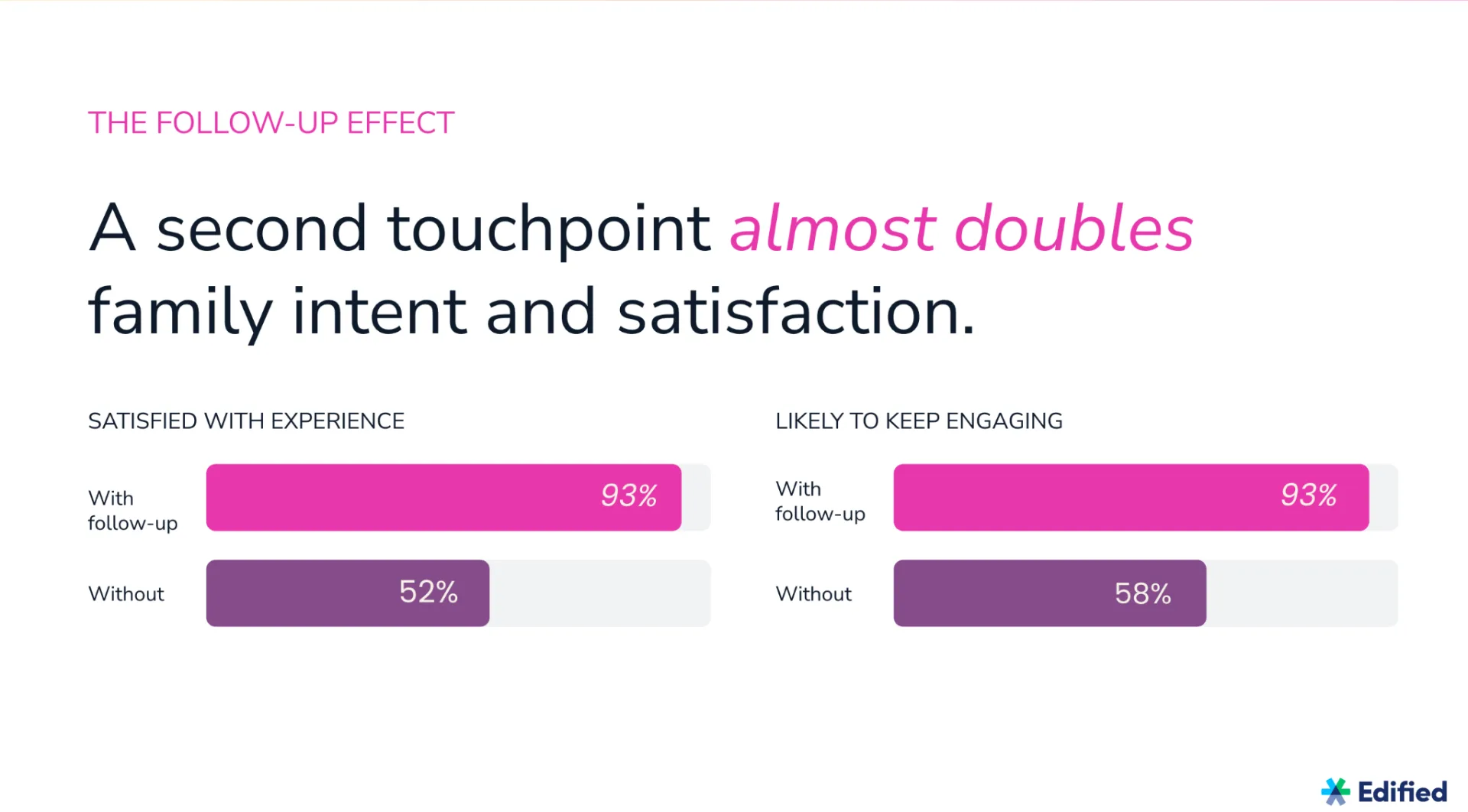
Silence is common. In Edified's 2025 tracker, only one in four mystery shoppers received any follow-up from a university after the first reply. Yet follow-up makes a real difference. When Edified mystery-shopped 51 international schools, 93% of families who received a follow-up were satisfied with their experience, compared with 52% of those who didn't. The gap was almost as wide for intent: 93% of followed-up families said they were likely to keep engaging, against 58% of the rest.
We explore these findings in our on-demand webinar, The Silent Cost of Enquiry Follow-Up: How Schools Are Losing Enrolments They Never Knew They Had.
Start with the basics: every new enquiry acknowledged quickly, and owned by a named person on your team. A family who waits a week for a reply, or gets three different answers from three different colleagues, is already forming a view of your school.
Alexia Roumpou, a solutions consultant for OpenApply, saw this from the other side of the desk when she was choosing a school for her own daughter. The schools that went quiet after she applied left her assuming the worst. The one she chose was the one where she always knew what was happening next, and which kept finding small, well-timed reasons to stay in touch. Read Alexia's story.
Next, give your team the full picture of each family in one place: every email, call and visit, where they are in the journey, and what should happen next. Relationships are much easier to build when nobody has to piece together the history from memory or old email threads.
Then make follow-up timely and personal. A family interested in boarding, or in a child starting secondary school, wants different information from a family looking at the early years. Messages that match a family's interests and stage feel like a conversation. Generic newsletters feel like a mailing list.
What good looks like: a defined response time and an owner for every enquiry, one shared view of each family's history and next step, and follow-up tailored to where each family is.
3. Convert with Less Friction

Are you addressing families' concerns, or only getting in touch when you need a missing document? Once a family starts an application, the questions come: fees, timelines, assessments, whether their child will settle. A school that only makes contact to request paperwork feels like a bureaucracy. One that answers concerns before families have to ask feels like a community they want to join.
Do families know their next step, or are they waiting two weeks for a reply? When a family abandons an application, it's often not because they've changed their mind. They stall: a missing document, an unclear next step, an interview date that slipped past. When families can see what they've completed and what's still outstanding, they always know what to do next.
Automatic reminders handle the routine prompts, such as a missing school report or an upcoming assessment. That keeps families moving without your team chasing each one by hand, and leaves their time for the conversations that actually reassure families.
It's also worth knowing where families most often stall. If a large share pause at the same step, that step is probably the problem: a form that's too long, a document that's hard to get, or a fee that arrives too early. Fixing it once helps every family that follows.
What good looks like: families who can always see their next step, proactive answers to common concerns, automatic reminders for anything outstanding, and clear sight of where in the journey families most often pause.
4. See the Whole Picture

The first three stages are about how each family experiences your school. This one is about whether you can see that experience across every family at once.
If finding out how many families are at each stage means combining three spreadsheets, the answer will always be a little out of date. Live numbers for enquiries, applications, offers and enrolments let your team act while the cycle is still running, not review it once it's over.
Conversion rates between stages tell you even more. Strong enquiry numbers with weak applications point to a nurture problem. Plenty of applications with few completions point to friction. Each rate shows you which of the first three stages needs attention, without asking your team to work it out by hand.
This matters beyond the admissions office. Heads and governors make staffing, capacity and budget decisions based on expected enrolment. Reliable reports, available early, mean those decisions rest on evidence rather than guesswork.
What good looks like: live funnel numbers without manual spreadsheets, conversion rates between every stage, and reports leaders can rely on in time to plan.
How Growth-Ready Is Your Admissions Funnel?
Moving from collecting applications to managing relationships doesn't mean asking more of your team. It means giving them the processes and systems to make every family feel looked after, at every stage. Most schools are already strong at one or two stages and less so at others. The useful question is which stage is holding yours back.
Our admissions funnel assessment helps you find out. It takes you through twelve questions across the four stages in this article, from how you capture enquiries to how quickly your leaders can see reliable numbers. You'll come away with a clear picture of where your funnel is working, and where the next gains are likely to come from.
Want to see the data behind this article? Download the Admissions Performance Report